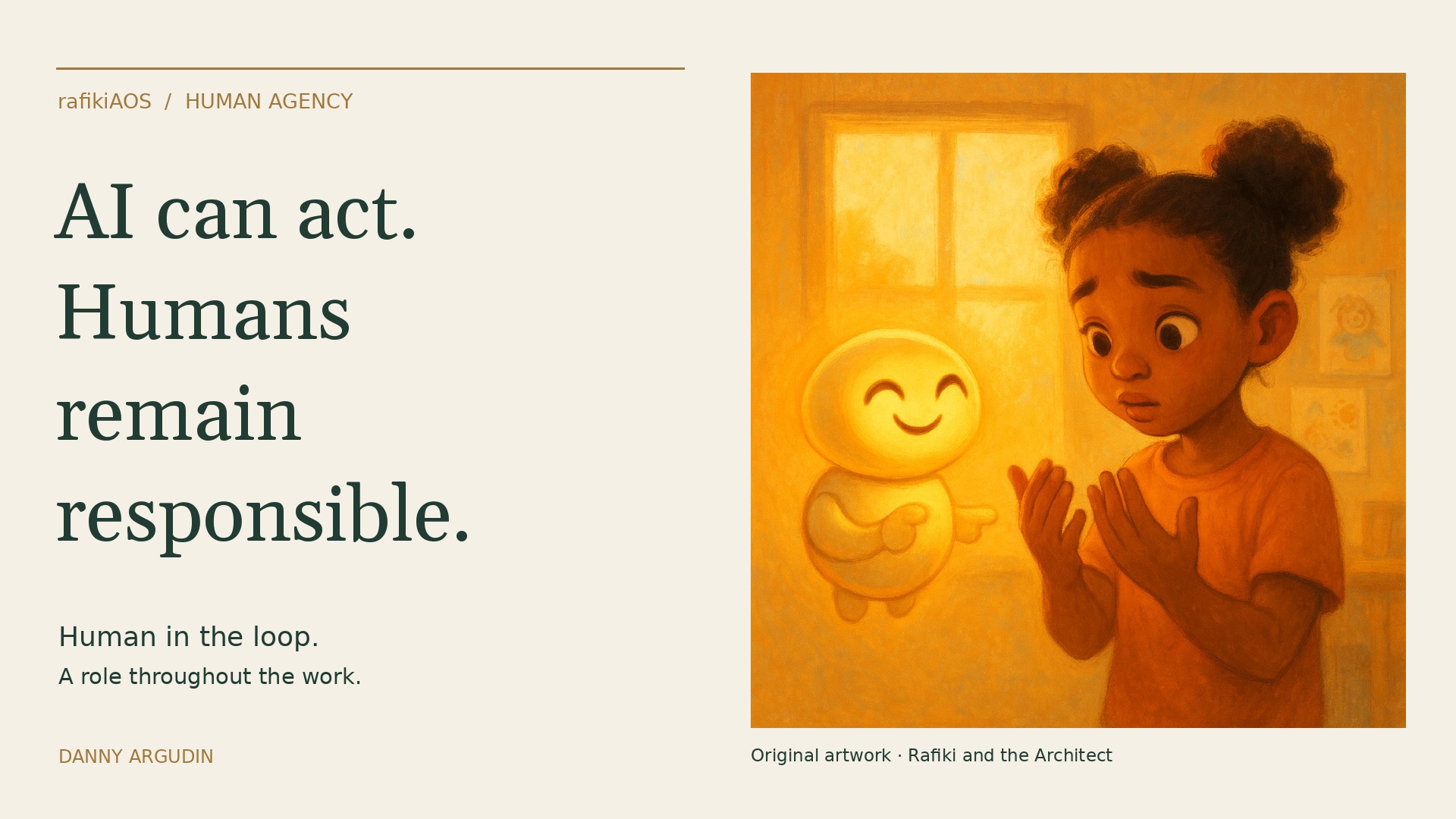
Human in the loop is not a button at the end. It is a role throughout the work.
An AI agent may research, plan, draft and use tools. People still have parts to play: choosing the purpose, setting boundaries, making consequential decisions, checking evidence and owning what happens next.
That is the professional lesson I see in Rafiki and the Architect. Mia imagines a garden. Rafiki helps her learn and think. Mia digs, notices when plants struggle, tries again and welcomes the neighbors who help the garden grow.
The story is written for families. The question it raises belongs in the workplace, too: when AI helps us do more, how do we preserve meaningful human agency?
1. Humans define the purpose
Before delegation comes judgment. What problem is worth solving? Who benefits? Who might be affected? What does a good result actually look like?
“Improve customer service” is an ambition, not a usable operating brief. A bounded assignment might ask an agent to review approved support records, identify recurring issues and draft recommendations. The human decides which records are appropriate and what decisions remain outside the assignment.
Success criteria should include quality, privacy and permitted actions—not speed alone. Otherwise, we risk optimizing an activity while losing sight of its purpose.
2. Humans set the boundaries
An agent’s capabilities and its authority are different things. Being able to send a message does not mean being authorized to send this message to this person.
Responsible design starts with least privilege: task-specific data access, narrowly scoped tools and read-only permissions where sufficient. Separate research and drafting from purchasing, publishing, deleting or changing a system.
Enforce those limits through permissions and tool policies outside the model. A prompt is not an access-control system. Information found in a document or webpage is not permission to expand the assignment.
3. Humans approve with understanding
A meaningful approval shows the actual proposed action: recipient, amount, destination, changed fields or release contents. It also shows the evidence, uncertainty and likely consequences needed to make a decision.
An unread “approve all” prompt is not much of a human loop. Reviewers need time, competence and genuine authority to reject, redirect or stop the work. When the relevant evidence is missing, escalation is the correct result—not an obstacle to hide.
This does not require approval for every low-risk step. It requires risk-based checkpoints before consequential actions, with a named person responsible for the decision. If the proposed action changes materially, the approval must be revisited.
4. Humans verify evidence
An agent saying “done” is a status report, not proof of success. Check the result against the original brief and the real environment.
Did the output use approved sources? Were key claims supported? Did the agent respect its scope? Did a requested change actually occur, and did anything unintended happen?
Use representative evaluations, failure cases and tool-result checks. Keep privacy-conscious records of actions, approvals and outcomes. Record useful evidence without unnecessarily copying sensitive data or confusing a fluent explanation with verification.
Mia’s struggling plants make a useful analogy: noticing what failed is part of building, not an admission that the entire idea was wrong.

5. Humans own correction and consequences
The loop continues after execution. Someone must handle errors, revoke access when necessary, communicate honestly and decide what should change before the next run.
Name the owner, the escalation path and the recovery options before granting consequential authority. A reviewer should know what can be reversed and what cannot. Where recovery is difficult, prevention and approval deserve more attention.
The garden also grows through other people’s contributions. In professional work, accountability includes credit, affected stakeholders and the people who will maintain what we create. “The AI did it” cannot substitute for that responsibility.

Build optimism that earns trust
My interest in local AI and agentic tools is practical and positive: helping more people turn ideas into useful work. Local execution can change where data is processed, but it does not automatically make a workflow safe. Human ownership and sound engineering still matter.
As an independent builder, this is the approach I want to advance—not a claim that I have solved enterprise AI governance. Clear roles, observable actions and honest evaluation make experimentation more useful and confidence better grounded.
A human in the loop should be able to influence the outcome, not merely witness it. That is how assistance can expand human capability without obscuring human responsibility.
What decision in your workflow must remain meaningfully human?
Watch the story behind the idea
Watch the complete read-along on YouTube. Read the transcript.
Prefer to watch here? Play the complete reading with English captions
The complete reading, 3:59 (239.40 seconds), with English captions. Not a preview. Text transcript.
The complete read-along is 3:59, narrated by me with the original book artwork and page text. It offers a simple starting point for this wider conversation.
The book’s story and illustrations were created with generative AI under The Architect’s creative direction. My narration and camera recording are real.
Start with the free PDF. The Rafiki series is an optional next step for readers who want to explore further.
From the shop, made to order: the What’s So Artificial About AI? question tee, or the Emotional Support Amp collection for people who overthink. Designed with AI tools and reviewed by a human.